By: Lemony Snicket
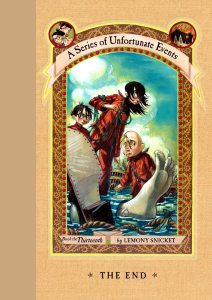
“Sooner or later, everyone’s story has an unfortunate event or two…The solution, of course, is to stay as far away from the world as possible and lead a safe, simple life.”
Lemony Snicket, The End
*This post contains spoilers for The End and A Series of Unfortunate Events
This is it… The final installment in A Series of Unfortunate Events. Before starting this re-read I hadn’t really thought of all the references to other literature that took place in the story. Sure, there were obvious character names but most of the books took huge pieces from another work and fit it into the Baudelaire’s story.
I really enjoyed trying to figure out which book Snicket was referencing. Once I figured it out it was fun to find everything I possibly could that related to the other piece of literature.
For one last time here is my discussion of A Series of Unfortunate Events.
For a discussion on the first twelve books in the series, see the linked posts bellow:
Overview:
The last volume of the fabulously popular A Series of Unfortunate Events series, in which the history of the Baudelaire orphans is brought to its end.
You are presumably looking at the back of this book, or the end of the end. The end of the end is the best place to begin the end, because if you read the end from the beginning of the beginning of the end to the end of the end of the end, you will arrive at the end of the end of your rope.
This book is the last in A Series of Unfortunate Events, and even if you braved the previous twelve volumes, you probably can’t stand such unpleasantries as a fearsome storm, a suspicious beverage, a herd of wild sheep, an enormous bird cage, and a truly haunting secret about the Baudelaire parents.
It has been my solemn occupation to complete the history of the Baudelaire orphans, and at last I am finished. You likely have some other occupation, so if I were you I would drop this book at once, so the end does not finish you.
The End
Literary Character References
Several of the island inhabitants are name after literary characters who live on islands or who are shipwrecked themselves.
- Friday-Robinson Crusoe has a character of the same name and aids both main characters significantly.
- Miranda Caliban- A mix of two characters from Shakespeare’s The Tempest
- Ishmael- The narrator from Moby Dick who weaves the narration of daily life for the island people. The character also want everyone to use his nickname and ask everyone to “call me Ish”.
The Odyssey
A few things are promenatly related to The Odyssey are the drinking of the coconut cordial and the island’s sheep population.
The sheep are a reference to the Cyclops. The monster keeps a herd of sheep and after Odysseus blinds him he uses the animals to escape the island.
The drinking of the coconut cordial is a reference to the Lotus eaters. Just like the lotuses, the coconut cordial keeps the inhabitants complacent and agreeable to suggestions. The cordial has an opiate-like quality that makes the residents less likely to question any of the “suggestions” that Ishmael gives. In both cases the inhabitants lack the ability to see things clearly.
The Garden of Eden
As with many of the books in this unfortunate series, a story from the bible is referenced. The tree in the arboretum that bears apples is a direct comparison to the forbidden fruit in the garden of Eden.
The obvious comparison is that they are both apples but the fruit also represent knowledge. Once Adam and Eve eat the apple, they realize that they are unclothed and the illusion of Eden is lifted. Ishmael does not want the inhabitants to eat the apples in The End because it would cure them of the toxin and they might continue their mutiny. Instead, he risks all of there lives (and potentially the lives of everyone else in the world) so that he may be their savior and take them to a different cure.
The knowledge is also due to the fact that the tree hides all of the things that Ishmael has been keeping from the island residents. If they were to go to the tree they would then have all of the knowledge that Ishmael has hidden from them.
The Wizard of Oz
I haven’t heard this comparison before but I did find a similarity between Ishmael and the Wizard of Oz.
Ishmael is the mystical figure that in reality is just a man hiding behind what he has made others believe. Much like the Wizard of Oz he fakes mystical powers to retain his position. He is revealed to be just a man behind the proverbial curtain.
Things We will Never Know
Thirteen books later and very little resolution. The orphans are left to go back to a world that may still think they are killers and still have no home. To make matters worse, they now have a baby to take care of.
In the end of The End, the reader is left to ponder the fates of most characters.
All of the Islanders take off in their boat after refusing to eat the apples that would cure them. It is possible that they made it to the mainland to receive another antidote. More likely, they all perished on the water except Ishmael who had been eating apples all along.
The Baudelaire siblings face a similar fate. One would think that the main characters of children’s books would survive. However, their fate is never revealed and the reader is left to draw their own conclusions. It would be fitting for them to not make the trip and one more unfortunate event.
One fate we do get is that of the dastardly Count Olaf. However, in his death Olaf reveals that he was not the one to set the fire that killed the Baudelaire’s parents. He also shares a moment with Kit Snicket that suggests he is a more complicated character than the reader was led to believe.
Overall,
This book serves as a way to wrap up the Baudelaire’s story as best as possible. Of course, so much is left to ponder and the door is open for more adventures.
Most final books wrap up everything nicely and give some sort of resolution to character arcs. Definitely not this one. We do get the death of Olaf but he leaves more questions for the siblings to answer.
This is the longest book in the series but could easily be double the size and still not be able to answer every question.
In The End, the reader is left to finished the story for themselves.
Rating: 3.5/5 stars
 FableStoryNovel