By: Jennifer Saint
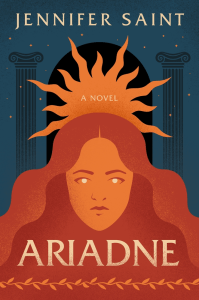
“Was this my punishment? To live the reality of my dream and find out that its glittering beauty faded to nothing when I stepped close?”
Jennifer Saint, Ariadne
*This post contains spoilers for Ariadne
Overview:
Ariadne, Princess of Crete, grows up greeting the dawn from her beautiful dancing floor and listening to her nursemaid’s stories of gods and heroes. But beneath her golden palace echo the ever-present hoofbeats of her brother, the Minotaur, a monster who demands blood sacrifice.
Ariadne
When Theseus, the Prince of Athens, arrives to vanquish the beast, Ariadne sees in his green eyes not a threat but an escape. Defying the gods, betraying her family and country, and risking everything for love, Ariadne helps Theseus kill the Minotaur. But will Ariadne’s decision ensure her happy ending? And what of Phaedra, the beloved younger sister she leaves behind?
Hypnotic, propulsive, and utterly transporting, Jennifer Saint’s Ariadne forges a new epic, one that puts the forgotten women of Greek mythology back at the heart of the story, as they strive for a better world.
A Classic Story from Greek Mythology
The book retells all of the myths that include Ariadne and combines them into one continual story. It also focuses on the women of Greek myth. Often, Greek myth is told from the hero or God’s point of view. Women are often casualties of the story and easily dismissed as a tool for the main character to further their story.
Ariadne includes classic characters such as: Theseus, the Minotaur, Daedalus, Icarus and many of the Greek Gods.
Foreshadowing
Early in the story, Ariadne tells the story of Scylla. This story foreshadows Ariadne’s journey. A princess who betrays her father and country for the love of a man. In Scylla’s case King Minos uses her information to win his battle and then kills Scylla in a horrible way. It’s all there within the first few pages of the book. This story ins’t there by accident or for background its a warning of what is to come.
Ariadne knows better. She has heard of her father taking no mercy on Scylla and using her to advance himself. Theseus does the same with her. It is almost an mirror image of her betrayal except that Theseus leaves her to die as opposed to brutally murdering her.
The argument is that Ariadne never had a chance with either side she chose. Theseus used her and her father would have married her off to a horrible nobleman. She chose to take a chance and trust a stranger that she had only had one conversation with.
Fate
Throughout the story fate is interwoven. Phaedra’s fate is eluded to by Dionysus and Ariadne has to sit by a watch her fate come to pass.
This can sometimes be a lazy way of moving the story forward but this being Greek mythology gives it a pass. Everything in myth references fate and knowing that the die has already been cast on your life. This can lead people to do great things because they know they will succeed but also can give false confidence when fate is misinterpreted.
Ultimately, choice is an illusion and everything has been predetermined a long time ago.
Overall,
The story is a direct retelling of the myths in which Ariadne is present in Greek mythology. Very little deviates and instead the author elaborates personal feelings and conversations of the characters.
I wish that the author used a little more creative license to make the story their own. I did still enjoy the book but I feel as if I could have read any other retelling and gotten the same experience.
Rating: 3/5 stars
 FableStoryNovel
One thought on “Ariadne”